

New 10 AI Art Prompts for Sci-Fi, Fantasy, and Surreal Digital Illustrations of Abstract Concepts
This collection gathers ten AI art prompts that all share one habit: they take a single reference photo and rebuild the person inside a layered, surreal or cinematic world. Some prompts orbit the subject with neon grid frames, some slice a circular background into radial panels, and others stack torn-edge photographs like items pinned to an old map. The through-line is a central figure who stays recognisable while everything around them becomes concept art.
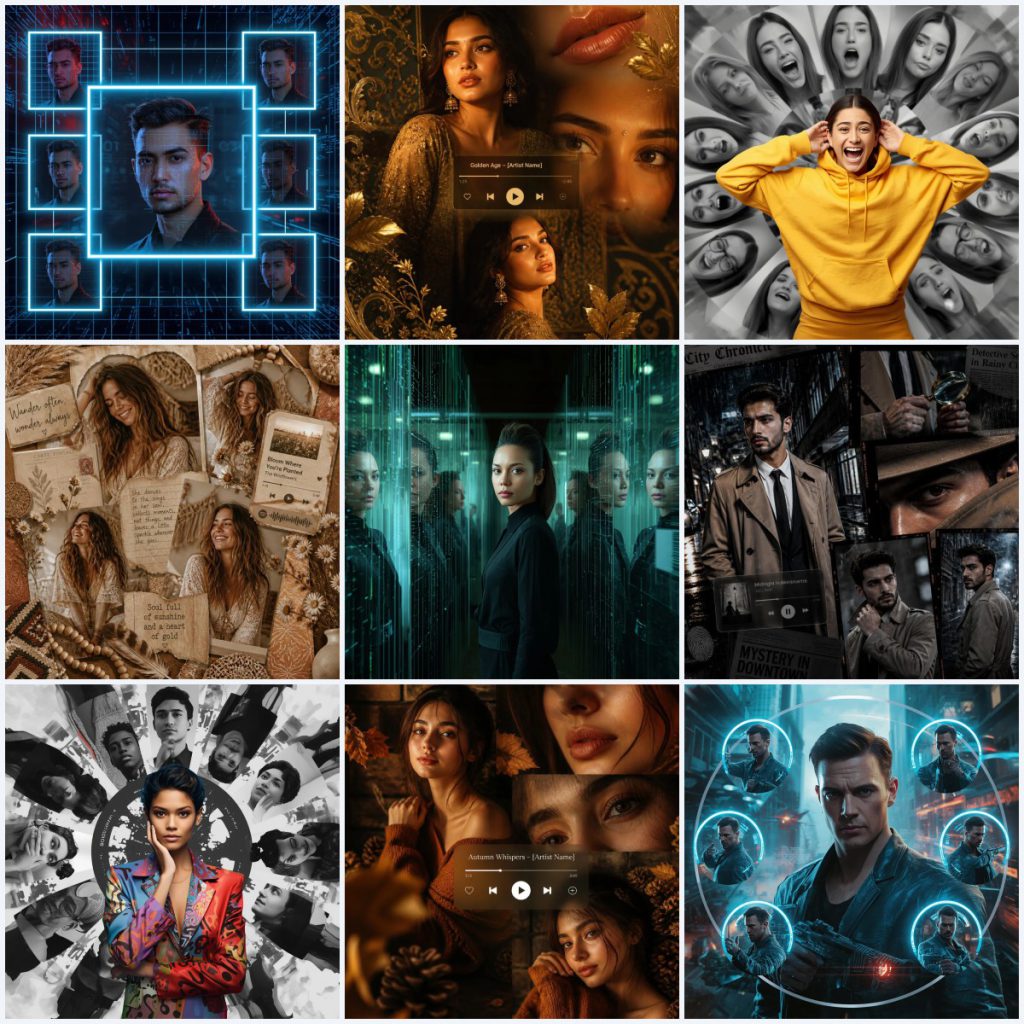
The set moves between sci-fi, fantasy, and abstract digital illustration. Neon Grid Cyberpunk and Holographic Arc Cyberpunk push glowing data and orbital frames. Fragmented Matrix Mirrorverse turns the backdrop into glitching screens and distorted code. Opulent Gold Collage, Warm Autumn Glow Collage, and Bohemian Rhapsody Scrapbook lean warm and tactile, while Vibrant Radial Collage and Ink Splash Radial keep the subject in colour against monochrome slices. Masculine Vintage Explorer and Masculine Urban Detective complete the group with sepia frames and gritty film textures.
What these reference-based collage prompts are asking for
Every prompt in this set treats the uploaded photo as the anchor and then builds a structured composition around it. The subject stays centred and readable, while frames, slices, or overlays carry the concept. Because the instructions are explicit about layout, lighting, and supporting elements, the results tend to look designed rather than random, which is exactly what makes them useful for social posts, posters, and profile art.
- A centred main subject matched to the reference face, hairstyle, and outfit
- Repeated smaller versions of the same person inside grid, arc, or radial frames
- Neon lines, holographic data displays, or glitching code lines as background structure
- A specific lighting mood: opulent gold, warm autumn glow, sepia, or soft diffused light
- Small aesthetic props such as gold-leaf filigree, dried leaves, pinecones, or pampas grass
- A semi-transparent music player overlay in the reel-style collage prompts
The shared scene across the set
Most of these images place one person at the centre of a busy but controlled frame. The cyberpunk entries ask for a subject who is "placed prominently at the center of the frame" and "in a static, confident pose with a determined expression" or, in the holographic version, "a dynamic, action-oriented pose with a focused and determined expression." Around that figure, square grid frames or arc-shaped frames orbit like satellites, each one holding a different version of the same face.
The collage prompts swap orbit for layering. A reel-style layout asks for "one main portrait (upper half body), one close-up of lips, one close-up of eyes, and one angled portrait at the bottom," while the scrapbook version wants "organically shaped photo frames of the same person in a layered layout, slightly tilted and overlapping." The explorer and detective prompts go further and specify "4–5 overlapping torn-edge frames, resembling old photographs tacked onto a map."
Why this set works for portrait experiments
These prompts are built for people who want a concept image that still looks like them, not a generic character. The reference photo does the identity work, and the prompt does the world-building, so the output keeps a real face inside a stylised frame. That balance is hard to hit with a plain text-to-image description.
- Identity stays intact because each prompt repeats that the subject must match the reference image
- The layered frames create visual interest without hiding the main face
- Each prompt fixes its own lighting and palette, so the mood is consistent across variations
Three style directions inside this collection
The collection covers three distinct style directions, and each one is already written into the prompt text. You are not choosing between them so much as picking the prompt that matches the mood you want. All three keep the reference subject as the visual anchor, so the difference is atmosphere rather than subject matter.
- Cyberpunk digital overlay: Neon Grid Cyberpunk and Holographic Arc Cyberpunk wrap the subject in glowing lines, data displays, and orbiting frames for a sci-fi look.
- Luxury and warm collage: Opulent Gold Collage, Warm Autumn Glow Collage, and Bohemian Rhapsody Scrapbook use gold-leaf accents, dried leaves, terracotta tones, and soft diffused light.
- Gritty vintage narrative: Masculine Vintage Explorer and Masculine Urban Detective use sepia tones, torn edges, scratched film negatives, and props like a compass or magnifying glass.
How to run any of these prompts
The workflow is the same for all ten prompts, because each one depends on a real reference photo rather than a written description of a person. Start with a clean, well-lit image where the face is unobstructed, then let the prompt handle the layout. Expect to run two or three generations before the composition settles.
- Copy the prompt. Take the full prompt text for the card you want and paste it into your image tool without trimming the layout instructions.
- Upload your reference. Attach a sharp, front-facing photo with even lighting so the model can match face, hairstyle, and outfit.
- Generate the first pass. Run the prompt once at your usual resolution and check whether the central subject and the frame structure both appeared.
- Check the hands. Zoom in on any hand holding a compass or magnifying glass, and regenerate if fingers are fused or misshapen.
- Check the face. Confirm the main portrait still resembles the reference before you worry about the smaller repeated frames.
- Check the main object. Verify the grid, arc, or torn-edge frames are present and that the props sit where the prompt asked.
Choosing the reference photo
The reference image decides how much of the concept survives. These prompts repeat face, hairstyle, and outfit matching, so a photo that already shows those clearly gives the model less to guess. A simple background also helps, because the prompt is going to replace it anyway.
- Use a front-facing or three-quarter shot with the face fully visible and evenly lit
- Avoid heavy filters, because the prompts already apply their own colour treatment
- Wear the outfit you want preserved if the prompt asks to keep your original dress
Tools that handle these prompts well
Any modern image generator can attempt these prompts, but the ones that accept a reference image and follow long layout instructions will save you the most time. The table below compares four common options against the kind of detail each prompt demands.
| Tool | Access | Typical realism | Useful here for |
|---|---|---|---|
| ChatGPT | Web and app, paid tiers for image generation | Good for stylised and illustrative output | Rewriting the neon grid or arc frame instructions into a shorter, clearer brief |
| Google Gemini | Web and app, free tier available | Solid for clean portrait renders | Quick drafts of the radial collage slice layout before you commit |
| Leonardo AI | Web, free credits plus paid plans | Strong photoreal portraits with reference support | Matching the face across the main portrait and the smaller torn-edge frames |
| Midjourney | Discord and web, paid subscription | High-end cinematic realism | The opulent gold lighting and deep shadows in the gold-leaf collage |
Practical tips for cleaner results
Small adjustments to the reference and the prompt text make a bigger difference than switching tools. These prompts are long, so the model has a lot to balance, and anything you simplify helps. The three tips below target the props and lighting that appear most often in this set.
- If the gold-leaf accents or filigree patterns overwhelm the face, lower their prominence in the prompt text and regenerate
- For the autumn collage, keep the dried leaves and pinecones described as foreground and side elements so they frame rather than cover the subject
- When a compass or magnifying glass appears in a hand crop, generate a few extra passes and pick the one with clean fingers
Common failures and what to change
Long prompts with layered layouts fail in predictable ways. The model may merge frames, drop props, or let the background reflections take over the centre. Most fixes are a matter of reordering or trimming the prompt rather than starting over.
| Issue | What to change |
|---|---|
| Background frames overlap the main subject | Restate that the grid, arc, or reflection elements must stay in the background only |
| Repeated small portraits stop resembling the reference | Reduce the number of inner frames and emphasise face matching in the main clause |
| Hand props like the compass or magnifying glass look distorted | Crop the hand out of the composition or generate more variations and select the cleanest |
| Monochrome slices bleed colour into the background | Reinforce that only the centre subject stays in full colour while the slices remain black and white |
Frequently Asked Questions
Do I need a reference photo for every prompt in this collection?
Yes. Each prompt is written around a reference image and repeats that the subject must match the uploaded face, hairstyle, and outfit. Without a reference the model will invent a person and the collage structure loses its point.
Can I use these prompts for a single image instead of a collage?
The collage prompts are built around multiple frames, so removing that structure changes the concept. If you want one clean portrait, the cyberpunk prompts are easier to adapt because they keep a single central subject with background elements.
Why do the smaller repeated portraits look different from the main one?
The prompts ask for varied poses, angles, and expressions inside the frames, so some drift is expected. If the drift is too strong, shorten the list of expressions and repeat that every version must match the reference image.
Conclusion
This set is a good starting point if you want portrait art that keeps a real identity while pushing into sci-fi, fantasy, and surreal territory. Pick the prompt whose lighting and frame style match your goal, upload a clean reference, and give it two or three runs before judging the result. The layered structures reward patience, and small edits to the prompt text usually fix the frames that misbehave.