

Best 10 Masterpiece AI Image Prompts for Hyper Detailed Premium Artwork of Majestic Mountain Ranges
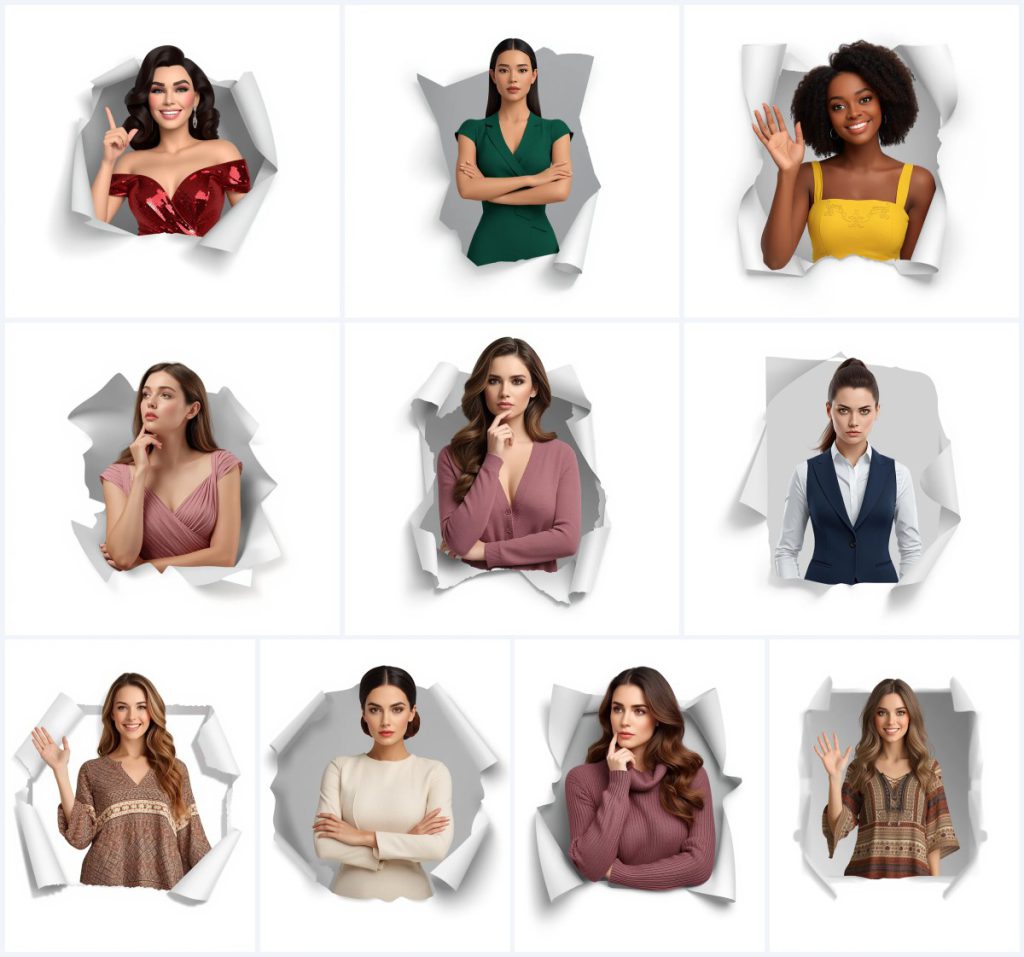
This collection gathers ten hyper-detailed prompts that all share one striking visual trick: a woman from the chest up pushing through a torn paper hole. The titles move from a crimson sequin gown to a dusty rose pleated gown, a mauve long cardigan, a navy blue vest, a patterned boho tunic, a textured cream dress, a mauve knit sweater, and several more. Each card keeps the same ripped-edge framing while changing the clothing, the pose, and the mood.
The shared scene is a studio-style 3D render with realistic torn edges wrapping around the half-body and a light grey gradient filling the space behind the paper. Because the collection repeats that structure, the useful work is in the variables: fabric, neckline, hair, gesture, and expression. The notes below explain what the set is asking for, how to keep identity consistent across all ten, and where soft tools tend to fail.
What this torn-paper portrait collection is asking for
Every prompt in this set describes the same beautiful woman from the chest up, captured in a polished 3D render with sharp, clean edges. The differences live in the styling and the emotional beat: a wink and a point, arms crossed calmly, a mid-wave with a bright smile, a hand resting on the chin, and a serious gaze under a furrowed brow. The torn paper hole is not decoration; it is the compositional device that frames the figure and creates a shallow stage for the character.
- A torn paper hole with realistic ripped edges wrapping around the half-body
- A light grey gradient filling the interior of the paper opening
- Crimson sequin gown with an off-shoulder design and figure-flattering silhouette
- Deep emerald green structured dress with a sharp V-neckline and tailored cap sleeves
- Sunny yellow cocktail dress with a fitted bodice and delicate embroidery details
- Soft mauve long cardigan with delicate button details and elegant long sleeves
The studio scene behind the ripped edges
The setting is minimal by design. The prompt says the woman is "emerging through a torn paper hole," and that the ripped edges wrap "naturally around her half-body." A "light grey gradient color subtly filling the inside" keeps attention on the face and the fabric rather than on a room. This is a portrait stage, not a lifestyle scene, so the paper itself becomes the only prop.
Poses vary but stay contained. One card places her "mid-wave, with an expansive, radiant smile," another shows her with "arms crossed confidently across her chest," and a third has "one hand gently raised to her chin, fingers lightly touching her jawline." The clothing follows the same logic: a "breathtaking crimson sequin gown" or a "soft, luxurious mauve knit sweater" with a comfortable cowl neck. The torn paper stays constant while the wardrobe and gesture carry the story.
Why this collection works for premium portrait tests
The torn-paper frame is a strong test of edge quality and depth, which makes this set useful for anyone comparing models or workflows. It also gives a clean identity anchor across ten cards, so you can judge consistency instead of guessing. And the varied wardrobe keeps the set from feeling like one repeated image.
- The ripped edges and grey interior expose how well a model handles sharp boundaries and shallow depth
- Repeating the same woman across ten prompts makes facial consistency easy to compare
- The range of fabrics, from sequins to knit, tests material rendering without changing the composition
Three looks inside this prompt set
Three distinct styles run through the collection, and each one stays inside the prompt rather than borrowing from outside it. The first is polished 3D glamour, the second is calm editorial minimalism, and the third is warm approachable character work.
- Polished 3D glamour: The crimson sequin gown, dramatic voluminous curls, and winking pose push the render toward Hollywood red-carpet energy.
- Calm editorial minimalism: The deep emerald structured dress, sleek straight hair, and crossed arms read as a quiet fashion editorial against the grey gradient.
- Warm approachable character: The patterned boho tunic, flowing light brown waves, and enthusiastic wave turn the torn-paper frame into a friendly portrait.
How to run these prompts without losing the paper effect
Work through the set one card at a time and keep the torn-paper clause untouched. Small edits to hair or fabric are safe; rewriting the framing clause usually breaks the illusion. Save your best result as the identity reference before moving to the next title.
- Copy the prompt. Paste the chosen card exactly as written so the torn-paper and grey-gradient clauses stay intact.
- Upload a reference. Attach a clear chest-up photo of the same woman so facial structure and identity carry across all ten prompts.
- Generate. Run the prompt at high resolution and produce several variations before judging the composition.
- Check the hands. Inspect the waving hand and the hand on the chin for extra fingers or fused knuckles.
- Check the face. Confirm the wink, smile, or furrowed brow matches the card and that the eyes are symmetrical.
- Check the main object. Examine the torn paper hole for clean ripped edges and a smooth grey gradient inside the opening.
Choosing the reference photo for this set
Because all ten prompts describe the same woman, the reference photo does more work than usual. A single strong chest-up shot will keep the collection coherent and make the clothing changes easier to read.
- Use a chest-up portrait with even lighting and no heavy shadows across the face
- Pick a neutral expression so the wink, smile, and serious looks can be generated cleanly
- Keep the background plain so the model does not blend it into the grey gradient behind the paper
Which tools handle this torn-paper render best
Different tools solve different parts of this set. Conversational editors are useful for swapping a gown color, while dedicated image models are better at the ripped edges and the polished 3D finish.
| Tool | Access | Typical realism | Useful here for |
|---|---|---|---|
| ChatGPT | Web and app | Moderate to high | Rewriting the crimson sequin gown into another color while keeping the torn paper clause |
| Google Gemini | Web and app | Moderate to high | Checking that the light grey gradient stays subtle inside the paper opening |
| Leonardo AI | Web | High | Generating the deep emerald structured dress with sharp V-neckline and tailored cap sleeves |
| Midjourney | Web and Discord | Very high | Producing the polished 3D render with realistic ripped edges around the half-body |
Tips that keep the paper and the wardrobe believable
The strongest results come from treating the torn paper as a physical object and the clothing as a material study. Small, concrete adjustments beat broad restyling.
- Keep the ripped edges irregular; a perfectly straight tear reads as a digital mask rather than paper
- For the crimson sequin gown, ask for individual sequins to catch light so the fabric does not flatten into red plastic
- For the mauve knit sweater and the mauve long cardigan, request visible stitch texture so the knit reads as soft wool rather than smooth clay
Common failures in this collection and how to fix them
Most problems here trace back to the paper frame or the hands. Fixing one clause at a time is faster than regenerating blind.
| Issue | What to change |
|---|---|
| The torn paper looks like a clean digital cutout | Add language about irregular ripped edges and small paper fibers along the tear |
| The waving hand has six fingers or a fused thumb | Lower the hand slightly and specify five separated fingers with a relaxed palm |
| The grey gradient fills the whole background instead of the paper interior | Restate that the light grey gradient sits subtly inside the torn opening only |
| The face changes between cards in the set | Reuse the same reference image and keep the identity clause identical across prompts |
Frequently Asked Questions
Can I use these prompts without uploading a reference photo?
Yes, but the ten cards will produce ten different women. The prompts describe the same beautiful woman, so a single chest-up reference is what keeps the collection consistent.
Why does the torn paper hole keep breaking in my renders?
The framing clause is fragile. If you shorten or paraphrase the part about realistic ripped edges wrapping around the half-body, the model often replaces it with a clean cutout or a full frame.
Which card is easiest to start with?
The deep emerald structured dress with arms crossed is the most forgiving, because the crossed arms hide hand detail and the sharp V-neckline gives the model clear geometry to follow.
Conclusion
This collection is less about ten separate pictures and more about one reliable portrait formula. The torn paper hole, the grey gradient, and the chest-up framing stay fixed while the crimson sequin gown, the emerald structured dress, the sunny yellow cocktail dress, and the rest rotate through. Run the cards in order, keep the reference photo steady, and check the hands, face, and paper edges before moving on. The result is a coherent set of hyper-detailed portraits that feel like one shoot rather than ten unrelated generations.
Only edit and publish photos you have the right to edit, and keep your reference images properly licensed.