

Best 10 AI Prompts for Epic Space Exploration Digital Paintings
Space exploration has always captivated the human imagination, and with AI image generation, artists can now bring the most ambitious cosmic visions to life. This collection of ten epic prompts pushes the boundaries of science fantasy, blending luxury civilizations, biological megastructures, and surreal cosmic phenomena into breathtaking digital paintings.
Each prompt in this set invites you to explore a unique universe where time flows through mechanical flowers, entire civilizations are stored within celestial whales, and knowledge spirals across galaxies like nebula rivers. Whether you're a seasoned AI artist or just starting your creative journey, these prompts offer endless inspiration for crafting detailed, cinematic scenes that feel both grand and intimate.
What this space exploration prompt collection is asking for
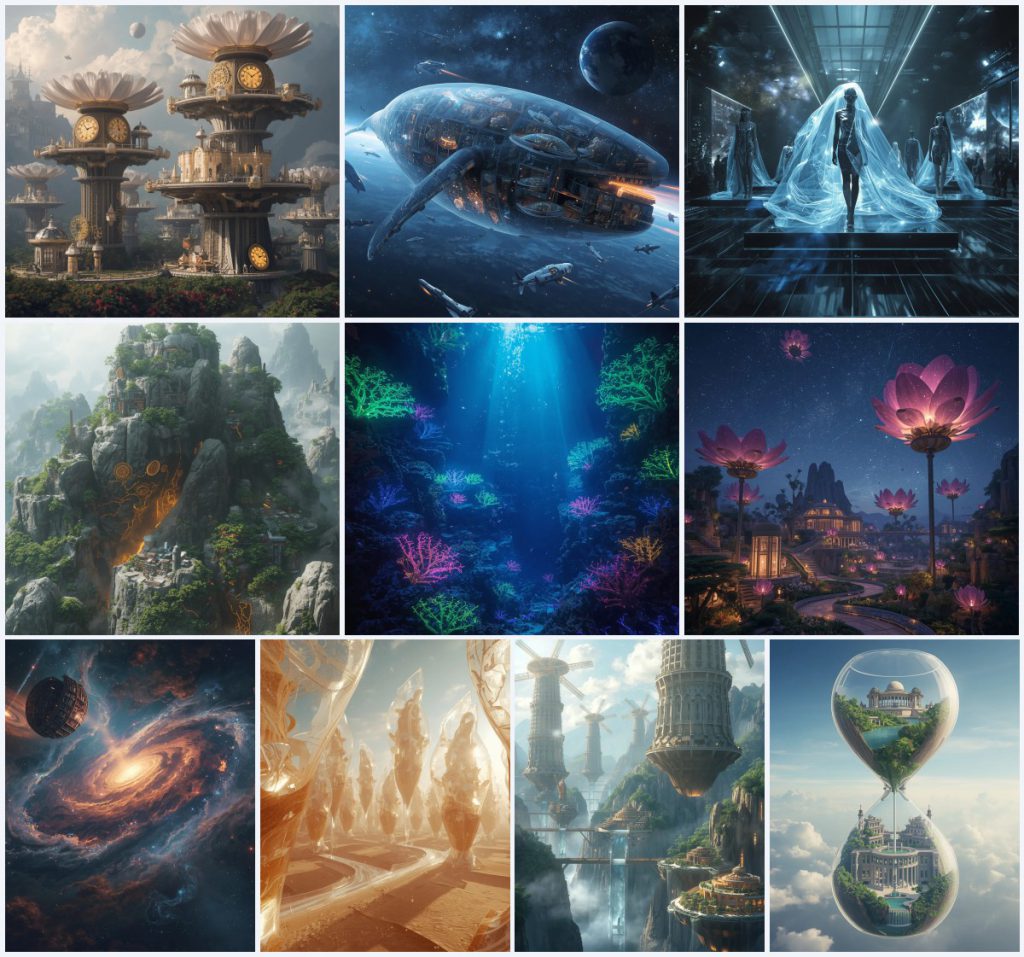
This collection of ten prompts describes a series of epic, fantastical environments that merge cosmic scale with intricate detail. Each scene is built around a central imaginative concept, such as a floating clock garden or a cyber-organic mountain megacity, and emphasizes luxury aesthetics, cinematic lighting, and extraordinary worldbuilding. The goal is to generate digital paintings that feel like windows into vast, living universes where nature, technology, and artistry coexist in spectacular harmony.
- Gigantic clock flowers with petals that open according to cosmic schedules, surrounded by golden gears and crystal gardens.
- A colossal celestial whale carrying thousands of preserved civilizations inside transparent crystal chambers embedded within its body.
- A luxury fashion runway floating in zero gravity, where fabrics flow like liquid energy against a backdrop of distant galaxies.
- A futuristic mountain transformed into a living megacity with rock structures behaving like biological systems and neural technology cores.
- A deep underwater world filled with glowing coral trees, neon aquatic plants, and bioluminescent creatures moving through layered water currents.
- A transparent hourglass floating in the sky, containing a futuristic observatory in the upper chamber and lush forests with rivers in the lower chamber.
Visualizing the epic space exploration scenes
The scenes in this collection are defined by their immense scale and intricate details, often combining organic and mechanical elements in unexpected ways. For instance, one prompt describes "an elegant fantasy civilization built around gigantic clock flowers whose petals open according to cosmic schedules," with "golden gears" rotating beneath "crystal gardens." Another envisions "a colossal celestial whale drifting peacefully through the cosmos," its body housing "thousands of preserved civilizations inside transparent crystal chambers." These clauses set the stage for images that feel both serene and awe-inspiring.
The environments are further enriched by dynamic elements like "glowing energy currents" flowing across surfaces, "sand particles floating in slow motion" around glass structures, and "data flowing across space like cosmic wind." The prompts consistently call for "ultra cinematic lighting" and "hyper realistic" rendering, ensuring that every generated image captures a sense of motion and depth. From "luxury sky villas" orbiting constellation flowers to "floating library structures" that orbit like planets, each scene is a self-contained universe waiting to be explored.
Why these space exploration prompts work so well
These prompts excel because they combine high-concept science fantasy with specific visual instructions, giving AI models a clear framework while leaving room for creative interpretation. The emphasis on luxury aesthetics, cinematic lighting, and hyper-realism ensures that the outputs are not only imaginative but also visually striking and suitable for professional portfolios or concept art.
- The prompts balance abstract concepts like 'cosmic schedules' and 'living archives' with concrete details such as 'golden gears,' 'crystal chambers,' and 'glowing energy currents,' making them easy for AI to interpret.
- Each prompt includes dynamic elements like zero-gravity fabrics, shifting light refractions, and bioluminescent movement, which add a sense of life and motion to the static images.
- The recurring themes of luxury, premium craftsmanship, and futuristic architecture create a cohesive aesthetic across the collection, making it ideal for series-based projects or worldbuilding exercises.
Three artistic styles that enhance these space exploration prompts
These prompts are designed to be versatile, but certain artistic styles can amplify their epic, cinematic qualities. By applying a consistent visual approach, you can unify the collection while highlighting the unique features of each scene. The following three styles are particularly effective for bringing out the detailed worldbuilding and atmospheric depth inherent in these space exploration concepts.
- Cinematic Sci-Fi Realism: This style emphasizes dramatic lighting, wide-angle compositions, and photorealistic textures, perfectly matching the prompts' calls for 'ultra cinematic lighting' and 'hyper realistic' rendering.
- Futuristic Fantasy Art: With its focus on imaginative architecture and organic-mechanical hybrids, this style brings out the luxury and surreal elements, such as the 'living constellation flowers' and 'gravity-powered watermills.'
- Bioluminescent Digital Painting: Ideal for the underwater and cosmic scenes, this style uses glowing color palettes and volumetric light effects to enhance the 'shifting colors' and 'celestial light patterns' described in the prompts.
How to generate these space exploration images with AI
Creating these epic space exploration paintings requires a structured approach to ensure the AI captures both the grand scale and the fine details. Follow these steps to achieve the best results, from setting up your prompt to refining the final output.
- Copy the prompt text. Select one of the ten prompts from the collection and copy its full text exactly as written to maintain the intended details and style.
- Upload a reference photo (optional). If you have a specific lighting or composition reference, upload it to the AI tool to guide the overall mood and framing of the scene.
- Generate the initial image. Paste the prompt into your chosen AI image generator and run the first generation. Use settings like 8K or cinematic mode if available.
- Check the main object. Examine the central element, such as the clock flower, archive whale, or glass metropolis, to ensure it matches the prompt's description and scale.
- Inspect hands and faces. If the image includes human figures, like models on the zero-gravity runway, zoom in to verify that hands and faces are anatomically correct.
- Refine and regenerate. Adjust the prompt with additional keywords like 'symmetrical,' 'no distortion,' or 'ultra detailed' if any elements appear warped, then regenerate until satisfied.
Using reference photos for these space exploration prompts
While these prompts are highly descriptive, reference photos can help anchor the AI's output in recognizable visual language, especially for elements like lighting, textures, and architectural styles. Choose references that complement the fantastical nature of the scenes without overriding their imaginative core.
- Use a photo of a nebula or galaxy to guide the cosmic backgrounds, ensuring the 'distant galaxies' and 'abstract light grids' appear realistic and immersive.
- Select architectural images of luxury resorts or futuristic buildings to inform the 'premium craftsmanship' and 'sophisticated architecture' in the floating cities and observatories.
- Incorporate underwater photography references for the 'deep underwater world' prompt to help the AI render realistic water caustics and bioluminescent effects.
Best AI tools for generating these space exploration images
Different AI image generators offer varying levels of realism, accessibility, and control. The table below compares four popular tools and how they can be used to bring these epic space exploration prompts to life.
| Tool | Access | Typical realism | Useful here for |
|---|---|---|---|
| ChatGPT | Free/Paid | Moderate to High | Generating cohesive scenes with complex elements like the 'giant floating archive whale' and its crystal chambers. |
| Google Gemini | Free/Paid | Moderate | Quickly iterating on the 'cyber organic mountain megacity' to balance biological and technological details. |
| Leonardo AI | Freemium | High | Achieving the 'ultra cinematic lighting' and 'volumetric depth' described in the underwater neon forest prompt. |
| Midjourney | Paid | Very High | Rendering the intricate 'transparent hourglass floating' with photorealistic forests, rivers, and observatory details. |
Three tips for perfecting these space exploration prompts
To get the most out of these prompts, focus on enhancing the visual impact of specific materials and objects. Small adjustments can make the difference between a good image and a truly epic one.
- When generating the 'floating desert glass metropolis,' emphasize the 'translucent glass structures' by adding keywords like 'caustics' and 'refractive light' to make the reflections more dynamic.
- For the 'luxury floating clock garden,' highlight the 'golden gears' by specifying 'polished brass texture' and 'intricate clockwork mechanisms' to add mechanical realism.
- In the 'cosmic floating library universe,' focus on the 'books of light energy' by describing them as 'holographic tomes with glowing text' to make the knowledge elements more tangible.
Common issues and fixes for these space exploration prompts
Even with well-crafted prompts, AI generators can sometimes misinterpret complex scenes. Here are four common problems you might encounter and how to address them.
| Issue | What to change |
|---|---|
| The clock flowers appear flat or lack mechanical detail. | Add 'intricate gearwork' and 'layered metallic petals' to the prompt, and increase the weight of 'golden gears rotating.' |
| The celestial whale's crystal chambers look like simple bubbles. | Specify 'hexagonal crystal panels' and 'miniature glowing worlds inside each chamber' to enhance the structural complexity. |
| The zero-gravity runway has stiff, unnatural fabric movement. | Include 'dynamic cloth simulation' and 'slow-motion liquid fabric flow' to emphasize the physics of the scene. |
| The underwater neon forest lacks depth and appears murky. | Adjust with 'volumetric light rays,' 'clear water visibility,' and 'layered foreground coral' to create a sense of space. |
Frequently Asked Questions
Can I combine elements from multiple prompts in this collection?
Yes, you can mix concepts like the 'floating luxury planetarium garden' and the 'giant luxury gravity watermill' to create hybrid scenes, but be sure to balance the details so the AI doesn't get overwhelmed by too many competing elements.
What aspect ratio works best for these epic space exploration scenes?
A 16:9 widescreen ratio is ideal for capturing the cinematic scale, especially for prompts like the 'surreal cinematic city' or 'cosmic floating library universe,' as it emphasizes the vast environments.
How can I ensure the luxury fashion elements look realistic in the zero-gravity prompt?
Focus on fabric textures by adding terms like 'silk,' 'metallic thread,' and 'weightless drapery' to the prompt, and use a reference photo of haute couture to guide the garment designs.
Conclusion
This collection of ten epic space exploration prompts offers a gateway to creating stunning AI-generated digital paintings that blend fantasy, science fiction, and luxury aesthetics. From the serene beauty of floating clock gardens to the monumental scale of gravity watermills turning mountain chains, each prompt is a springboard for your imagination. By experimenting with styles, tools, and refinements, you can produce a cohesive series of artworks that showcase the limitless possibilities of AI-assisted creativity. Let these prompts inspire you to build entire universes, one breathtaking image at a time.
Remember to only edit and use photos you have the legal right to modify, ensuring your creative process respects copyright and ownership.